
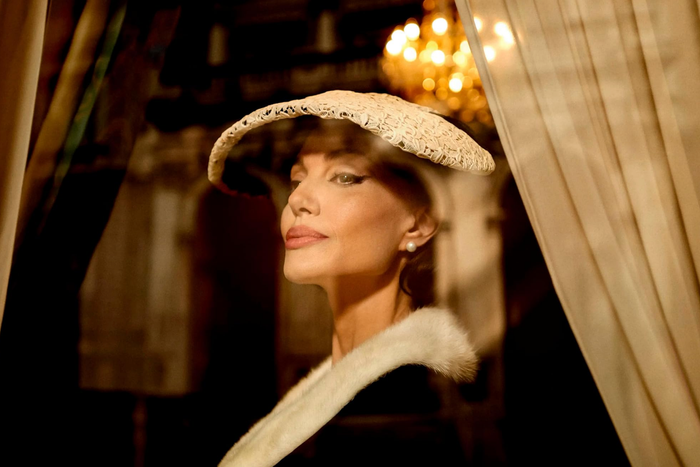
The first thing that strikes you about Pablo Larraín's Maria is how goddamned brown everything is. Not sepia. Brown. The Parisian apartment of Maria Callas experienced an untidy entry of Autumn which resulted in complete disorganization of all spaces. Edward Lachman directs his camera as if he were using tobacco water to create paintings which effectively convey the overwhelming sense of memory that fills 1977 Paris. Less so when you're watching opera's most vibrant personality die.
Actually, that's unfair. Some of it's green. Sickly green that pools around Jolie whenever Larraín wants us to know she's dying. Which is constantly.
Guy Hendrix Dyas recreates her Avenue Georges Mandel home with oppressive grandeur (that bed alone, eight feet of carved Italian excess), but they shoot it like a mausoleum tour. Everything preserved under glass. Even Jolie moves through space like an expensive specter in Massimo Cantini Parrini's flowing robes.
The selection of colors creates ongoing distress for me. The final credits display Callas in her actual life as she laughs with bright colors. But Larraín drowns his Callas in muddy palettes except for the black-and-white Onassis flashbacks, which at least have visual clarity.
Jolie possesses the ability to sell an imperious image. The main challenge she faces is exposing herself but she reveals her vulnerability in a single moment when she finds out about Onassis' marriage to Jackie through newspaper reports. She performs Callas as if she remains fully conscious of being observed at all times.
The Mandrax hallucination device? Kodi Smit-McPhee plays both her imaginary documentarian and personification of her sedative addiction. Almost works. "This is the part of the film where you're expected to sing, Maria," he tells her. The director uses every element to create direct symbolic meanings in his work. Orchestra in rain. Dancers swirling.
Steven Knight's script gives us "Music is born of misery" and "For a Prima Donna, pleasure is unavoidable."Sounds exactly like what someone thinks an opera diva would say. The movie continuously explains her tragic situation instead of showing how it develops naturally.
Wait, the singing. Jolie underwent seven months of training before her vocals were merged with Callas's pre-recorded tracks. Effect sits weird. Not quite lip-syncing, not quite authentic. Everything at this place exists between living and dying without ever making a decision.
I kept thinking about what Callas says: "99% of your devotion is about food. 1% is about love."This film's proportions are off too. 90% surfaces, 10% the woman underneath.
The Callas footage that plays during closing credits serves as an essential component of the film. The film fails to show this woman who possessed multiple identities as she dies from a single extended and elegant respiratory collapse.
| Original title: | Maria |
| Verdict: | 👎 Don't watch |
| Runtime: | 124 minutes |
| Rating: | R |
| Released: | November 27, 2024 (theatrical), December 11, 2024 (Netflix) |
| Cinematographer: | Edward Lachman |
| Production Designer: | Guy Hendrix Dyas |
| Costume Designer: | Massimo Cantini Parrini |