
People develop unusual behavior during autumn season. Always has. And Alain Guiraudie gets this, which is why he drops Jérémie into a damp November village where everyone seems to want him but nobody knows what to do about it.
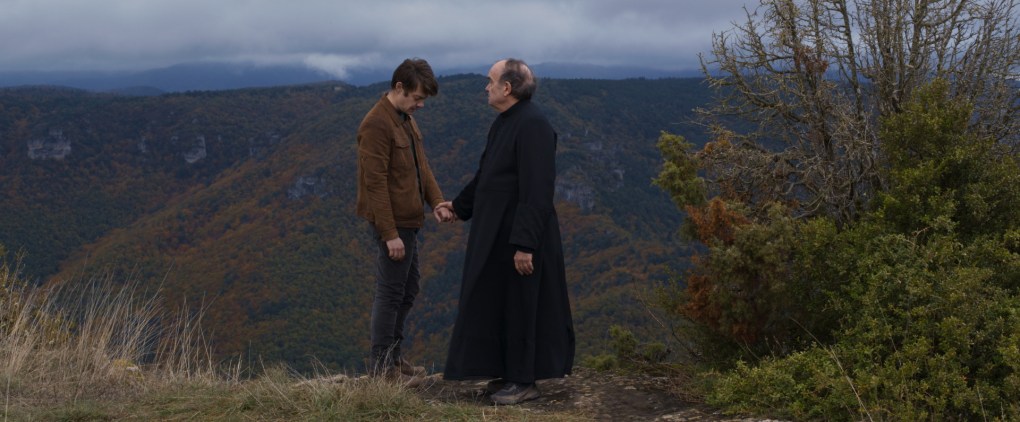
The chestnut trees display their golden colors when Jérémie reaches the location. Guiraudie and cinematographer Claire Mathon capture this Occitanie landscape in muted yellows and browns that feel like rust spreading through the frame. Not decay exactly, more like dormancy. Everything waiting. The mushrooms sprouting from wet earth. People standing in doorways. Watching.
Félix Kysyl brings Jérémie to life through his unengaging pale blue eyes which show no interest. He could be thirty. Could be older. The person moves with the confidence of someone who used to be the pretty boy but understands that period of their life has passed. When Martine shows him photos of her dead husband in speedos and asks if he's still in love with Jean-Pierre, he just confirms it. No flinch. Like saying he adds sugar to his coffee. The casual statement creates a chain reaction throughout the entire village as people move in slow and disoriented circles.
Actually, wait. Let me reconsider that speedos photo moment. The experience produces a sensation which deviates from what you would normally expect. Catherine Frot's Martine shows no signs of shock or criticism. She just asks. Everyone here treats desire like weather, something that happens to you. The film refuses to make a thing of what would be a whole plot point elsewhere.
Vincent wears earth tones. Always earth tones. His jacket, his sweater, everything the color of wet bark or dead leaves. The costume choices here are doing overtime, telling you these people haven't left this place, can't leave it. Meanwhile Jérémie shows up in this blue shirt that marks him as other, as city, as someone who got out once. Then Martine starts dressing him in her husband's clothes and the blue disappears. The village completely absorbed him into its depths.
The forest wrestling scenes between Vincent and Jérémie appear to be filmed in an unusual manner. Not erotic exactly. More territorial. Animal. The camera shows multiple positions which make it impossible to understand if the characters are fighting or not. Then Jacques Develay's priest shows up picking mushrooms, watching them with this expression. Not shocked. Interested. Develay plays him with this bounce that feels wrong for a man of God. Too cheerful. Like he knows the punchline already.
The murder occurs at a rapid pace. No buildup. Just happens. (I won't spoil the how.)The following section shows Jérémie handling the body through an extended silent sequence. Mathon's camera sits still, watches him work. The area will serve as a future home for the mushrooms although this approach seems either extremely clever or completely over-the-top. Can't decide.
The priest offers to provide an alibi in exchange for affection but Jérémie accepts this deal. Not reluctantly. Just practical. Like paying rent. The cops show up, find them in bed together, and the priest marches to the door completely naked. Doesn't cover up. Tells them to get lost. They do. Nobody in this village reacts to anything the way they should.
The habit of Walter to pour too much pastis into glasses continues to haunt me. David Ayala portrays him as someone who lost interest in measuring things during his years of experience. Walter declines Jérémie's advances because he experiences more fatigue than any actual desire. Everyone wants something from everyone else here but they're all too tired to follow through.
The color scheme continues to disturb me. All these browns and golds except for sudden bursts. A red scarf. Green mold. The blue of Jérémie's eyes against all that autumn. Mathon uses color to indicate ownership and non-ownership through her marking process. Except by the end nobody really belongs anywhere.
Guiraudie wants this to be funny. Sometimes it is. The cops are incompetent in that specifically French way where bureaucracy defeats purpose. But the comedy sits weird against the violence. Not uncomfortable exactly. Just off-center.
Actually, the whole film operates in this emotional uncanny valley where nothing quite registers right. People treat murders as if they were insignificant problems that needed to be solved. A priest provides false alibis with bureaucratic efficiency. "Death is not an end; it is simply a passageway," says the priest, and he means it literally, transactionally. Death as paperwork.
The film lacks the deliberate direction which Stranger by the Lake maintained throughout its entire duration. Misericordia continues to drift away because she becomes preoccupied with mushrooms and old photographs and the feel of wool sweaters. The situation has evolved into a complex mess which has lost its original path. Which might be the point. Real desire doesn't follow thriller logic. The loop operates indefinitely until someone becomes lost in the forest.
| Original title: | Misericordia |
| Verdict: | 👎 Don't watch |
| Runtime: | 104 minutes |
| Rating: | R |
| Released: | March 21, 2025 |
| Director: | Alain Guiraudie |
| Cinematographer: | Claire Mathon |
| Costume Design: | Branko Neškov |