
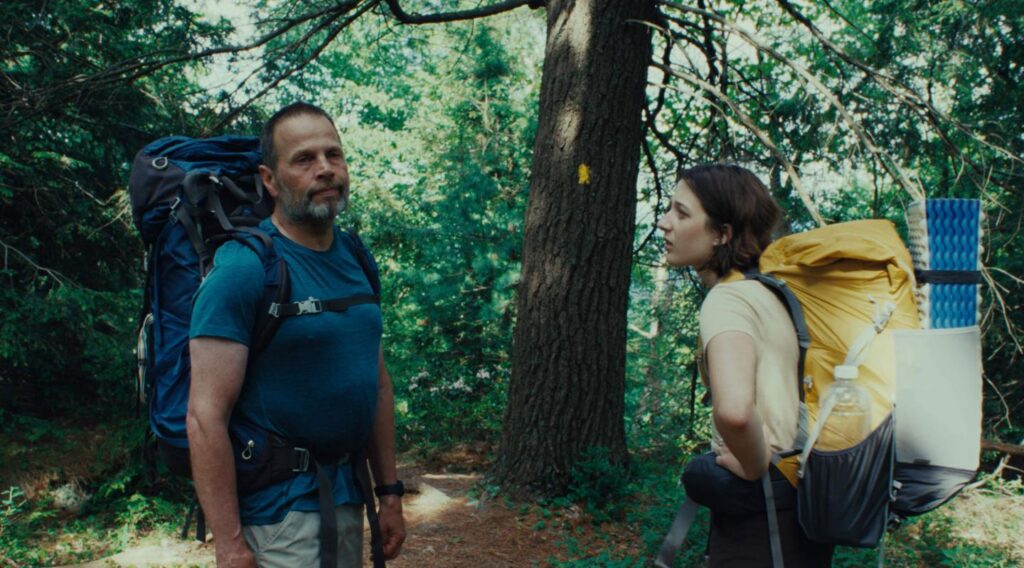
There's a particular silence that happens when you realize someone close to you has failed you, and they don't even know it yet. You carry it alone for a moment, sometimes longer. Maybe you carry it home. India Donaldson's Good One lives inside that silence, and it does so with a patience that feels almost radical.
The premise is simple. Sam, a seventeen-year-old on the edge of college, goes camping in the Catskills with her divorced father Chris and his longtime friend Matt, a recently divorced actor unraveling at the seams. Matt's son was supposed to come, too, but he bails. So Sam becomes the only young person among two middle-aged men who have known each other longer than she's been alive. They reminisce. They needle each other. They talk at her, around her, occasionally through her. She listens. She cooks. She dismantles the tent. It is, for much of its runtime, a film about being quietly useful while nobody particularly notices.
I want to say that nothing happens. That's not quite true, though it's closer to the truth than most synopses would admit. What happens is incremental, atmospheric. The men's banter, charming at first, curdles almost imperceptibly. Their vulnerability starts to feel less like openness and more like entitlement, a kind of emotional labor extraction wrapped in campfire confessions. And Sam, played by Lily Collias with a stillness that borders on the uncanny, absorbs it all through her face. There's a moment when Matt, drunk and perhaps believing he's earned some intimacy, tells Chris about his daughter: "You got a good one." It lands like a small rock in still water.
Then comes the turn. It's one line of dialogue, spoken casually, almost offhandedly. I won't spoil it. But what Donaldson does afterward is extraordinary: she lets the camera sit on Collias's face in the half-light of a dying fire, and you watch Sam understand something about the world she cannot un-know. There's no music. No reaction shot from Matt. Just time, and the sound of the forest doing what it always does.
What struck me most, actually, was the morning after. Sam tells her father what happened, and his response, or rather his failure to truly respond, becomes its own betrayal. "Let's just have a nice day," Chris says, and the words hang in the air like a door quietly closing. It reminded me of all the times I've been asked to make things easier for someone else by simply not feeling what I felt. You learn that trick young, if you're paying attention.
Comparisons to Kelly Reichardt are inevitable, and fair enough. Both filmmakers trust stillness. Both understand that dialogue can function as a kind of weather, something to move through rather than extract meaning from. But Donaldson is doing something slightly different. She's less interested in landscape as metaphor and more interested in how women, young women especially, become the infrastructure of other people's emotions without anyone quite acknowledging it.
Good One is not angry. That's what makes it so devastating. It's observant, and precise, and heartbreakingly tender toward a girl learning that her father cannot protect her from everything, least of all himself.
The final shot offers a small rebellion, laced with something like humor. But Sam's face has changed by then. Something has closed, or opened. I'm not sure which.
| Original title: | Good One |
| Verdict: | 👍 Watch it! |
| Director: | India Donaldson |
| Writer: | India Donaldson |
| Lead Performances: | Lily Collias (Sam), James Le Gros (Chris), Danny McCarthy (Matt) |