
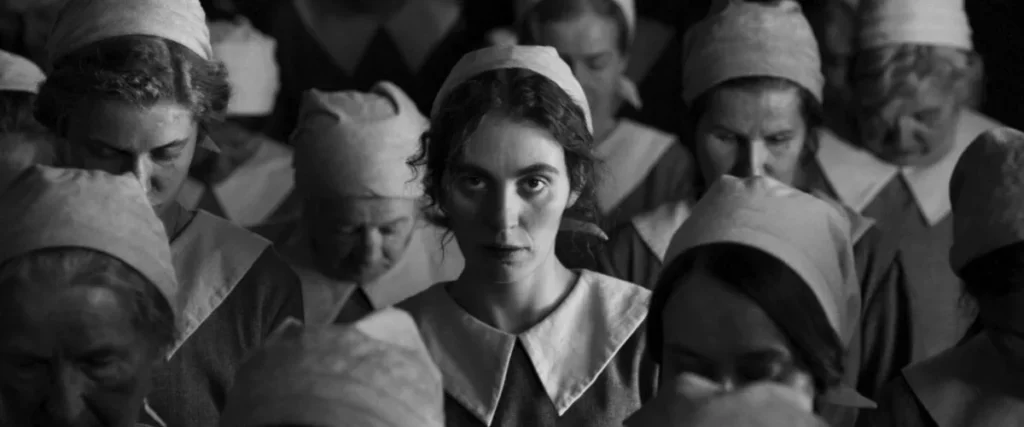
Some films sit with you the way a conversation does after you've already said goodbye and closed the door. You replay a phrase, a pause, the thing that was almost said. Magnus von Horn's The Girl with the Needle left me like that, standing in my kitchen at midnight, holding a glass of water I'd forgotten to drink.
Copenhagen, 1919. A city I know well, though not this version of it, all sharp shadows and expressionist dread. Vic Carmen Sonne plays Karoline, a factory seamstress whose life unravels with the quiet efficiency of thread pulled from a seam. Her husband is presumed dead in the war. She's pregnant by her wealthy employer, who discards her the moment his mother disapproves. The film watches her fall, and fall, and then shows us what waits at the bottom.
What waits is Dagmar.
Trine Dyrholm plays her with a warmth that feels, at first, like salvation. A candy shop. An offer to find homes for unwanted babies. A mantra she repeats to every desperate mother: "You've done the right thing." But Dyrholm does something remarkable here. Or maybe von Horn does. She lets us see the kindness and the horror coexist without ever resolving which came first. Dagmar isn't a villain hiding behind sweetness. She seems to genuinely believe her own justifications, which is infinitely worse.
The film draws loosely from the real Dagmar Overbye, Denmark's most prolific serial killer. But von Horn isn't interested in true crime mechanics. He's interested in the architecture of impossible choices, how a society that offers women nothing will eventually produce women who offer each other something monstrous disguised as mercy.
Michał Dymek's black-and-white cinematography makes Copenhagen look like a Bergman film that wandered into a nightmare and decided to stay. The verticality of the shots, the way faces half-dissolve into shadow. It's claustrophobic in the truest sense: walls closing in slowly enough that you don't notice until you can't breathe.
What I keep returning to is Sonne's face. She carries guilt, survival, complicity, and something like hope across two hours with an openness that makes the horrors land harder. Late in the film, Dagmar tells her: "The world is a horrible place. But we need to believe it is not so." It could be a thesis statement. It could be a confession. The film declines to clarify.
I should mention this is not an easy watch. The pacing is deliberate, almost meditative, and the relentlessness occasionally tips toward monotony. I noticed it. I also found I didn't mind, which surprised me.
Von Horn trusts us to sit with discomfort, to not need catharsis, to leave with questions. Deeply unfashionable filmmaking. I admire it enormously.
I biked home afterward, past the canal, thinking about the mothers who walked through that candy shop door. The film doesn't judge them. It just shows the door, and the world that made walking through it feel like the only option.
| Original title: | The Girl with the Needle |
| Verdict: | 👍 Watch it! |
| Director: | Magnus von Horn |
| Writers: | Magnus von Horn, Line Langebek |
| Lead Performances: | Vic Carmen Sonne (Karoline), Trine Dyrholm (Dagmar) |