
Right off, something gets under my skin about this sequel. Not the sandworms. The color grading in the film creates an unpleasant effect on me. Fraser recorded these Abu Dhabi dunes during December when the sun created a gloomy atmosphere and the colors transitioned from Paul's warm amber scenes to an icy medical-like tone during Harkonnen scenes. Works in theory. In practice? A perfectly planned environment becomes too perfect when everything appears to be in perfect order.
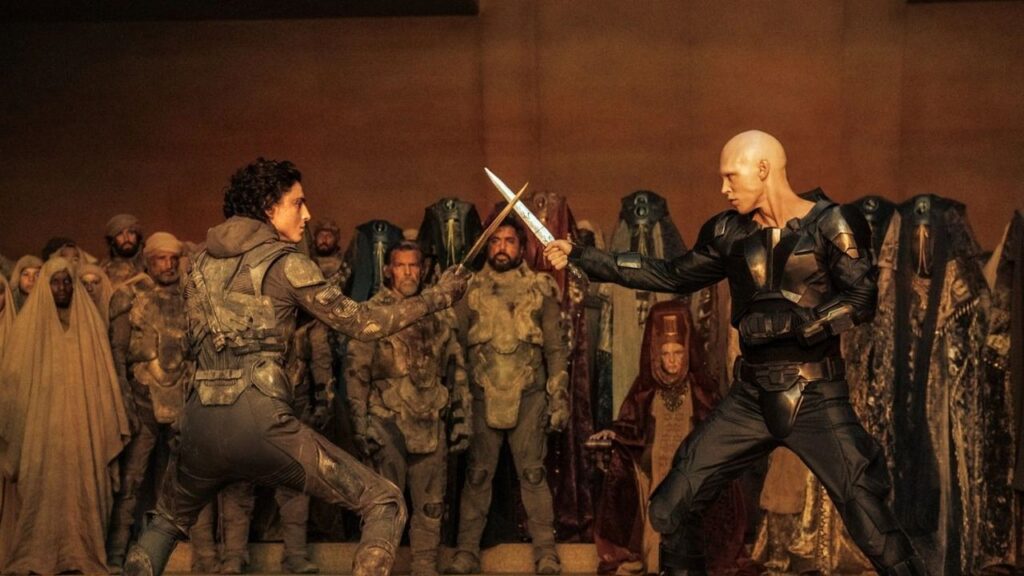
Actually wait, let me take that back partially. The Giedi Prime sequences. The black sun and infrared cameras create an X-ray like effect which reveals all evil aspects. That's commitment. Butler's gladiator scene plays out in this bloodless monochrome that somehow feels more violent than if they'd painted the arena red. His skin looks translucent. Like you could see through to whatever passes for a soul in there. Jacqueline West needed to create an entire new costume because the infrared light made certain fabrics appear white instead of black. Fascinating problem.
The film establishes its visual thesis through the assembly chamber scene where Paul declares himself Lisan al Gaib. Fraser deliberately frames Paul through raised Fremen knives, which feels obvious until you realize it works precisely because it's obvious. Sometimes the sledgehammer is the right tool.
The film continues to present difficulties regarding its approach to scale in its narrative. Everything's massive yet Paul remains this sulky teenager in oversized prophet's clothing. Chalamet performs his role by mimicking a theater student who accepts an unsuitable part while giving it his complete dedication. When he stomps his foot demanding the Emperor kiss his ring, it's so petulant it almost wraps back around to terrifying. Almost.
(Look, the wormriding scene is genuinely transcendent. The second unit of Fraser began filming this sequence before the official start of principal photography. You can tell. It's the only time the film stops calculating and just lets itself be ridiculous in the way sci-fi should be.)
The costumes West created deliver more narrative value than half of the spoken dialogue. The northern Fremen people chose practical clothing but the southern fundamentalists preferred expensive handmade ceremonial robes which cost more than my monthly rent. The Bene Gesserit shift from simple robes to these architectural headdresses the deeper south you go. Religion as fashion statement. Clever.
The anti-fireworks on Giedi Prime. Black liquid splattering against black sky to celebrate violence. Fraser ran video of jellyfish and arc welders through the lighting system, which sounds insane but creates this deeply uncomfortable beauty that stays with you. The Harkonnens lack traditional human celebrations in their culture.
"Your father didn't believe in revenge. Yeah, well I do."That line delivery. Flat, matter-of-fact, adolescent. Villeneuve doesn't dress it up. No swelling score, no dramatic pause. A young individual chooses to destroy the universe because he possesses this ability.
Here's what bothers me though. The romance between Paul and Chani appears as a description of love rather than an actual depiction of it. They look gorgeous together obviously, all that golden hour desert light making everyone look like perfume ads, but there's no heat. No friction. Zendaya delivers the line "The world has made choices for us" with perfection yet the screenplay opposes this by reducing their relationship to basic Wikipedia information.
Actually the whole film sometimes feels like a Wikipedia summary. The film features stunning production values through Fraser's direction which earned its Oscar nomination but fails to deliver the dreamlike essence that Herbert's book requires. This is Dune as project management. Corporate psychedelia. The search for respectability makes the group give up its distinctive characteristics.
Those military thumpers though. And Stilgar becoming comic relief somehow works even though it shouldn't. Bardem plays true believer as comedy without mocking the belief itself. When Paul denies being the prophet and Stilgar whispers "As it was written!" like he just won the lottery, you understand exactly how fascism takes root through desperate hope. The believers will interpret anything as confirmation. The movie shows horror elements through its comedic approach to storytelling.
The nuclear explosion at the end of the film displays an appearance which matches my understanding of nuclear detonations that could occur on extraterrestrial worlds. The explosion appears correct yet it contains subtle differences which make it seem both familiar and completely alien.
Butler's Feyd-Rautha deserves more. The entire psychotic energy output resulted in only fifteen minutes of screen display. The final battle between him and Paul should have served as the complete third section of the story. The movie shows only five minutes of authentic filmmaking between its opening exposition and its predetermined ending.
I wanted more hallucination. The following spice visions fail to create meaningful storytelling. The film continuously explains what we observe while it should allow us to maintain our confusion about the events. Even Anya Taylor-Joy's cameo as adult Alia gets contextualized to death. The main reason for mystery exists to prevent any possible explanation.
Fine. The film received three and a half stars because of its technical excellence and Butler's dedication to his distinctive accent. But this could've been so much stranger.
| Original title: | Dune: Part Two |
| Verdict: | 👍 Watch it! |
| Runtime: | 166 minutes |
| Rating: | PG-13 |
| Released: | March 1, 2024 |
| Director: | Denis Villeneuve |
| Cinematographer: | Greig Fraser |
| Costume Design: | Jacqueline West |