
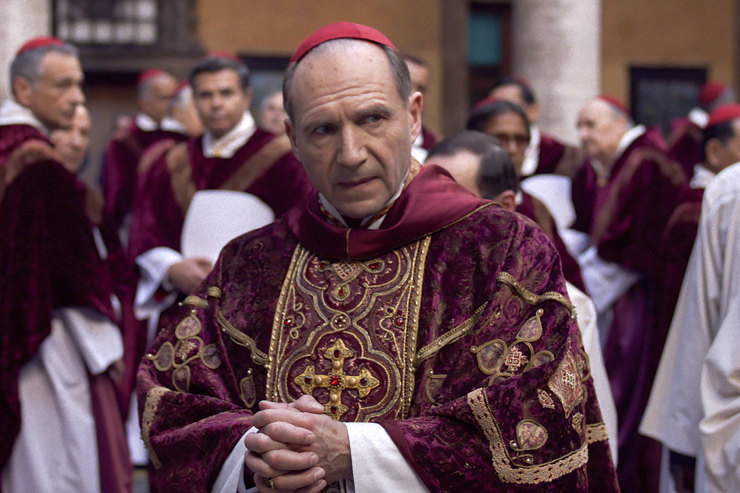
People discuss Conclave as if it were a reality show that clergy members participate in while wearing their religious robes. Honestly? I kept waiting for the mess.
The reds here work overtime. Berger shoots these cardinals against Vatican marble and every single robe becomes this visual exclamation point, scarlet bleeding into beige stone, then suddenly there's Rossellini's Sister Agnes in her whites cutting through the frame like judgment itself. The cinematographer Stéphane Fontaine uses his color choices effectively through his use of crimson shadows in ballot scenes and his transition to burgundy during tense moments. You begin to understand mood by analyzing how fabric saturation appears to you.
Actually, wait. Let me back up.
Fiennes plays Cardinal Lawrence like someone perpetually five seconds from a migraine, which feels right. "This is a Conclave, Aldo, it's not a war," he says to Tucci's progressive cardinal, who shoots back, "It is a war! And you have to commit to a side."Fine, whatever, but the film commits to neither camp. The design exists as a tasteful element although it should create an immediate powerful impact. Everywhere across the world people support this limitation. People hide their cowardice through complex word choices which they present as self-control.
The costumes reveal all necessary information before anyone starts speaking. Lisy Christl dresses Cardinal Tremblay from Lithgow in worn-out vestments which resemble middle management attire but Castellitto gives Tedesco conservative attire with precise pressed lines that resemble glass-cutting tools. Tucci's Bellini presents his robes as protective armor which he no longer wants to bear. The film lets viewers discover these elements by watching instead of showing them directly which I consider respectful although the dialogue occasionally betrays this approach through its use of fabricated religious explanations.
Look, can we talk about that turtle scene for a second? There's this moment with the late Pope's pet turtles from Angola just wandering around, getting run over occasionally, and Lawrence stops to watch them. The film almost becomes interesting here. Almost commits to absurdity. Then it retreats back into its prestige shell.
The whites in this film. Christ. Sister Agnes enters the screen through a bright medical light which contrasts with the deep red colors while Rossellini walks through the space with a sense that she understands what this movie should have been. "Although we sisters are supposed to be invisible, God has nevertheless given us eyes and ears," she says, and you want the film to follow her lead, to actually see something beyond its own careful choreography.
The Draughtsman's Contract appeared in my mind while watching because Greenaway demonstrated that palace politics require authentic hatred instead of repeated voting in elegant spaces. The Conclave follows a formal process which it presents as dramatic events. Multiple ballot rounds establish a structural rhythm but this rhythm does not create tension. The late Pope apparently kept massive secrets? Great. The film shows their discoveries through a perspective which makes their findings seem like ordinary administrative mistakes instead of groundbreaking discoveries.
That twist ending everyone whispers about lands with all the force of someone politely clearing their throat. The movie maintains its dignity even though it requires the kind of content that would normally be considered trash.
| Original title: | Conclave |
| Verdict: | 👎 Don't watch |
| Runtime: | 120 minutes |
| Released: | October 25, 2024 |
| Director: | Edward Berger |
| Cinematographer: | Stéphane Fontaine |
| Costume Design: | Lisy Christl |