
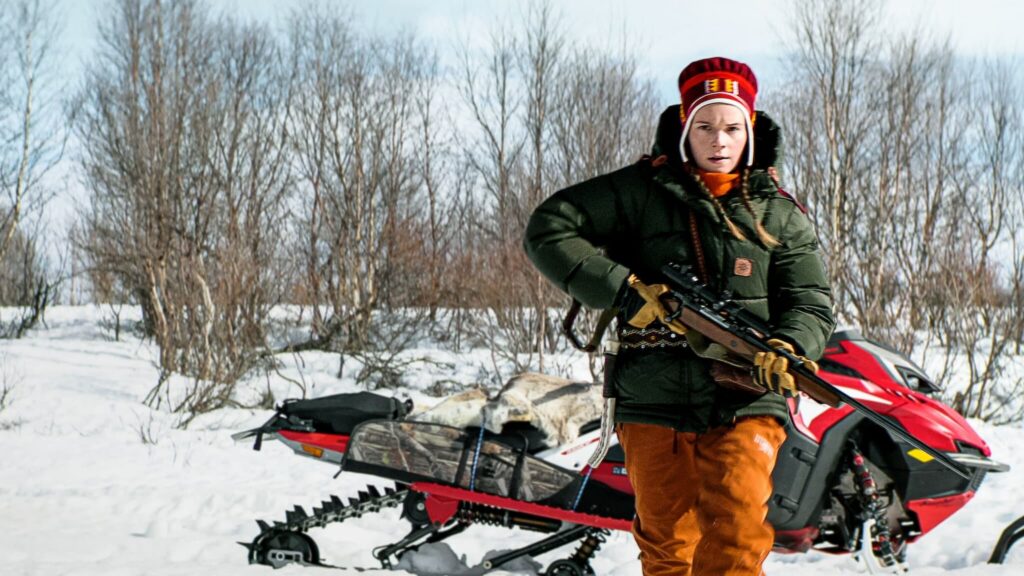
Unspoken words carry a unique weight. Stolen has that silence. It accumulates slowly, like snow on a windshield, and by the end you realize you have been holding your breath for reasons the plot alone cannot explain.
Elle Marja Eira's debut follows Elsa, a young Sámi woman in northern Sweden whose childhood was marked by a single act of violence: watching a man slaughter her reindeer, a white calf she had just chosen according to custom. The film opens with her grandmother's reminder that you never truly own a reindeer. They are only "on loan." It is the kind of line that sounds like folklore until you watch what follows, and then it sounds like grief wearing different clothes.
Ten years pass. The man, Robert Isaksson, is still there. Still killing. Still friendly with the police. And Elsa, played by Elin Kristina Oskal in a performance of extraordinary stillness, has spent a decade not speaking about what she saw. When she finally does, when she slams severed reindeer heads onto a police desk and says "I've only just started talking," the line lands not as catharsis but as exhaustion finally given a voice.
I should say: this is not a revenge thriller, despite what the marketing suggests. Or rather, it is not only that. Eira is less interested in the mechanics of confrontation than in the texture of endurance. How do you live alongside someone who has taken something irreplaceable from you? How do you stay in a place that keeps telling you, in small and large ways, that you do not belong? The film sits with these questions without rushing toward answers. It trusts the viewer to notice, for instance, how Elsa's brother Mattias moves through the world with a kind of quiet fracture, how her friend Lasse has already begun to disappear into despair. These are not subplots. They are the weather of the film.
Cinematographer Ken Are Bongo shoots the Swedish tundra with a beauty that never feels decorative. The landscape is vast and indifferent, and Eira uses that indifference to create a particular kind of tension, the sort you feel when you are alone and something is wrong and no one is coming. It reminded me, oddly, of waiting for a late train at an empty platform in winter. That specific vulnerability.
The film is not perfect. Some scenes feel underwritten, and the resolution comes a touch too neatly for a story that has spent two hours insisting on the impossibility of neat resolution. But these are minor complaints against a work that achieves something difficult: it makes you feel the weight of systemic injustice without ever becoming a lecture. The racism Elsa faces is not dramatized in loud confrontations. It is in the tea the police drink in Isaksson's kitchen. In the way town meetings pivot, always, toward economics.
What stays with me is Oskal's face. The way she holds everything just beneath the surface. You watch her and you understand that some things do not heal. They simply become part of how you move through the world.
I am still thinking about that white reindeer. On loan.
| Original title: | Stolen |
| Verdict: | 👍 Watch it! |
| Director: | Elle Marja Eira |
| Writer: | Peter Birro (based on the novel by Ann-Helén Laestadius) |
| Lead Performances: | Elin Kristina Oskal (Elsa), Martin Wallström (Robert Isaksson) |