
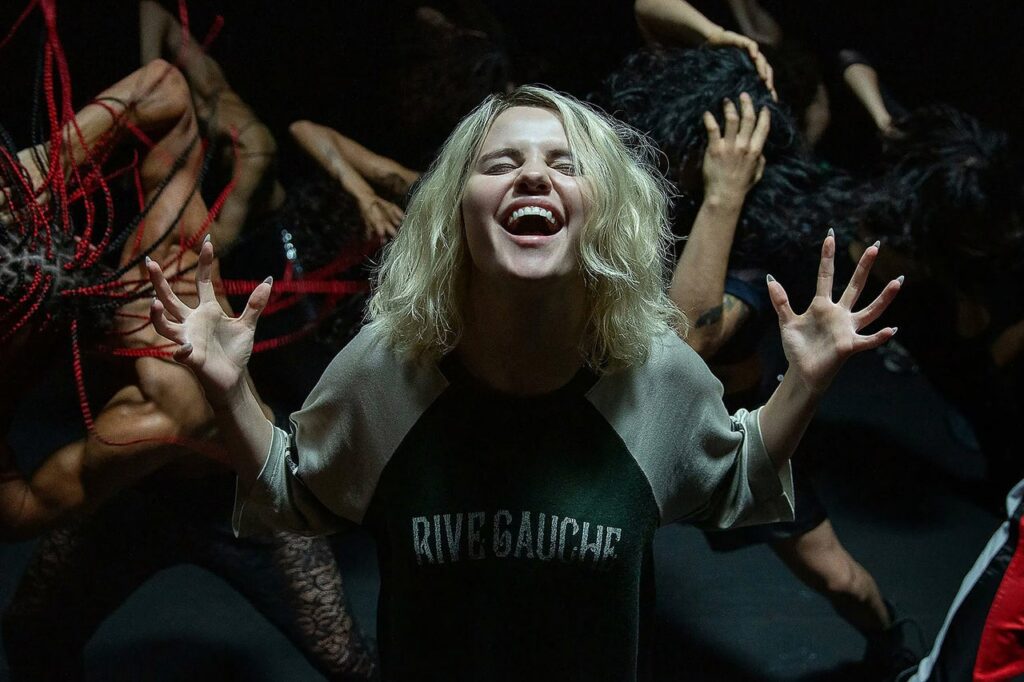
Look, Jacques Audiard made a telenovela-opera-cartel-trans-musical shot mostly on Parisian soundstages pretending to be Mexico City. You cannot make this stuff up. The entire project appears to result from someone who became heavily intoxicated at Cannes while writing down random concepts on bar napkins before deciding to bring those ideas to life. Which honestly, knowing Audiard, might not be far from what happened.
The film tracks cartel boss Manitas who wants gender-affirming surgery and hires lawyer Rita (Zoe Saldaña doing her damnedest) to orchestrate the whole transition slash disappearance. Emilia Pérez spent four years away from her family before she came back to reconnect with them while running a nonprofit that helps cartel victims. Yes, the same victims she created. The irony exists as a neon sign which no one ever connected to power.
Paul Guilhaume directs the entire film by using his determination to break free from reality. First act drowns in darkness, then suddenly we're in this candy-colored telenovela dreamscape after Emilia's surgery. Smart color work, I'll give them that. Guilhaume continues to discuss the process of removing definition from images which would result in less defined visual elements.
The characters' refusal to feel real creates an unusual effectiveness when viewers watch them. The Sony Venice camera functions as his main instrument to develop artificial elements which form the core of his artistic vision. A person's face becomes visible in darkness while all other people vanish from view. Mexico City becomes this abstract idea rather than a place.
Virginie Montel designed costumes which serve as the central element of this production. Rita begins her appearance in grey suits before she transforms into stylish red outfits while Emilia displays the elegant style which Montel describes as "Catherine Deneuve elegance" that suits her movie-based learning of femininity. The particular detail catches my attention. The Post Malone tattoos for Manitas, the bourgeois chic for Emilia. Montel gets that clothes tell the story these characters can't articulate. She collaborated with Anthony Vaccarello from Saint Laurent on this project while the high-fashion elements he brought failed to lift the sinking material.
The musical numbers. Christ. "Changing the body changes society, changing society changes the soul," Rita sings to a skeptical surgeon. The film employs circular reasoning to create an appearance of deep meaning which represents its entire intellectual foundation. Patients on gurneys move through a Bangkok clinic as staff members continuously say "Vaginoplasty!"Mammoplasty!"like it's a Busby Berkeley fever dream. I am trying to determine if this content is offensive or if it is simply an extremely unusual situation.
Selena Gomez shows up as the abandoned wife Jessi and the film keeps making her shout-sing in Spanish she barely speaks. Karla Sofía Gascón delivers authentic performances as Manitas and Emilia although the story lacks sufficient depth. She brings depth to the character who exists only as a theoretical concept in the script. Saldaña gets the big barnstorming number "El Mal" where she basically tells Mexico's elite they're all corrupt while they're funding this nonprofit for disappeared persons. Subtle as a brick. She at least makes an effort.
The whole thing builds to this shootout climax where Emilia reveals her identity through song while bleeding out. Really. Audiard thinks he's made something profound about transformation and redemption but mostly he's made an expensive mess.
The movie presents an unclear distinction between Emilia's transition serving as a disguise or leading to freedom because her charity activities might either forgive her cartel crimes or continue them through alternative methods. Every potentially interesting idea gets swallowed by the next musical number before it can develop.
| Original title: | Emilia Pérez |
| Verdict: | 👎 Don't watch |
| Runtime: | 132 minutes |
| Rating: | R |
| Released: | November 1, 2024 (limited), November 13, 2024 (Netflix) |
| Director: | Jacques Audiard |
| Cinematographer: | Paul Guilhaume |
| Costume Design: | Virginie Montel |