
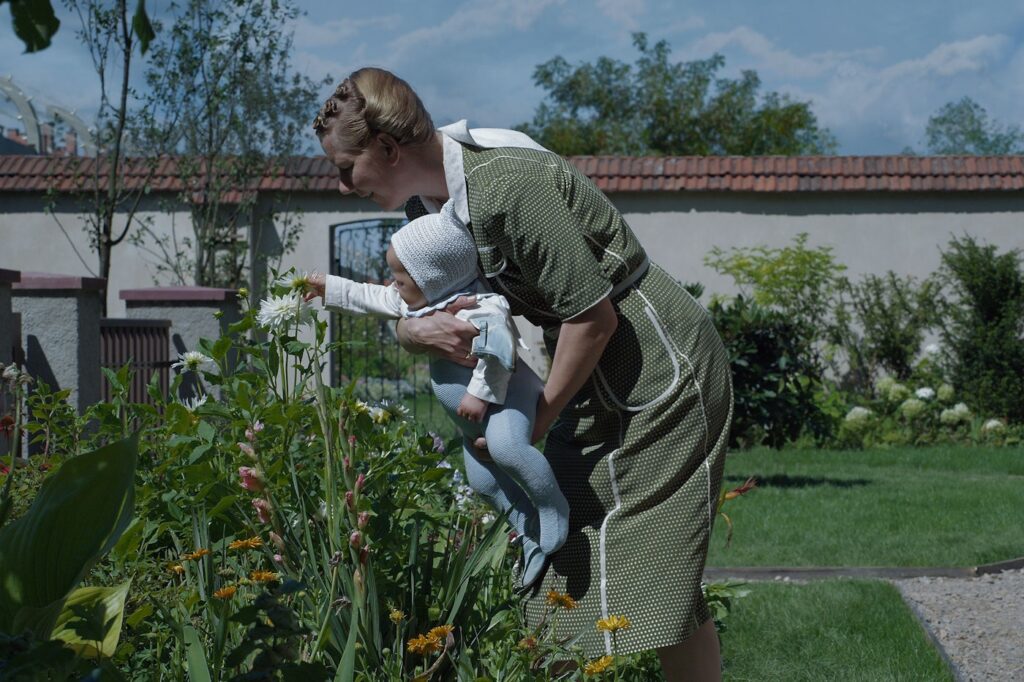
The filmmaker Glazer recorded his entire movie at the actual location which creates an authentic atmosphere throughout each scene. The sunlight that enters the scene through the concrete wall between Höss villa and Auschwitz creates a powerful effect in every frame. The family pool stands adjacent to dahlia beds and the greenhouse where tomatoes ripen while trains approach the property. The wall stays in my mind. The border exists because it fails to separate any important areas.
Look, here's the thing about Glazer's approach. The recreated Höss house contains ten hidden cameras which monitor the actors who remain alone in the space as if they are under constant surveillance. Which, fine. The flatness works. Łukasz Żal's cinematography refuses beauty even when filming beautiful things. The entire film appears lifeless because the color palette seems intentionally off-balance. The reds are too red. The greens appear sickly in appearance.
Sandra Hüller plays Hedwig Höss with this terrifying vacancy that keeps catching me off-guard. She shows her mother around while bragging about her accomplishments. "She refers to me as the Queen of Auschwitz according to Rudi while she finds it endearing. The mother needs to leave. Leaves in the middle of the night after seeing the chimney fires from her bedroom window. But Hedwig? She witnesses the same fires appear during each evening.
The film establishes a feeling of shared responsibility through its storytelling approach which involves extended periods of waiting. You're watching this family eat breakfast while somewhere, just past the frame, the machine grinds on. "Burn, cool, unload, reload," as the engineer explains to Rudolf about his new crematorium design. Continuously. The discussion about technical details occurred as if they were evaluating design improvements for a new dishwasher model.
Christian Friedel delivers a dual performance in Rudolf which demonstrates his professional demeanor and his emotional inner world. Reading bedtime stories, locking up the house each night, panicking when his children get ash on them from swimming. (Was going to say something about the Soła River scene but honestly, I'm still processing that one.)
Mica Levi's score drones. Just drones. The sound appears to transform into screaming noise which decreases in pitch until it reaches a textured quality. Sometimes it's nothing. Johnnie Burn's sound design does the real work here, though. Gunshots that could be hammering. The sound of possible machinery operation creates a loud scream. Dogs that never stop barking. You can't locate the sounds exactly. They exist as a natural part of the environment which appears in the same way as weather patterns.
The film barely moves. Rudolf faces the risk of transfer which makes Hedwig lose all control. She chooses to remain close to the death camp instead of leaving her garden behind. The lilacs, especially. The office received a memo about the lilacs.
The thermal imaging sequences appear to belong to a different film than the rest of the content. A Polish girl conceals apples for prisoners while everything appears as ghostly negative images. Too obvious, maybe? I think I wanted to remain locked inside that house because Glazer showed me the unbearable normal life that existed there.
No redemption here. Rudolf experiences a moment of recognition while he stands in a stairwell during the final part of the scene. Or maybe just nauseous. The story moves to modern-day Auschwitz where we see museum staff members who perform janitorial work. The film just stops. Doesn't conclude. Stops.
I can't shake the lipstick. Hedwig finds it in a confiscated fur coat pocket, tries it on. Two gunshots in the distance. Cut. That editing rhythm, Glazer and Paul Watts just chopping scenes without warning. Nothing flows. You're always catching up.
The 1990s had Schindler's List. Our nation required someone to act as our Schindler who would serve as our nobility. This refuses all that. These people aren't monsters because monsters are extraordinary. They are individuals who choose to view other human beings as non-human entities. The film knows you know what's happening beyond that wall, so it doesn't show you. The process of watering petunias gains deeper meaning through your daily observations of this activity.
The wall stays in my mind continuously.
| Original title: | The Zone of Interest |
| Verdict: | 👍 Watch it! |
| Runtime: | 105 minutes |
| Rating: | PG-13 |
| Released: | December 15, 2023 |
| Director: | Jonathan Glazer |
| Cinematographer: | Łukasz Żal |
| Costume Design: | Waldemar Pokromski |